liver
The 5 Elements of Chinese Medicine for Knicks-Mania

For the first time in 53 years and the first time in my life it looks like the Knicks can do it. I never thought this would happen. Even in the past few years, as they improved and made progress in the playoffs, my non-expert understanding was that we were a second-tier team. We’d make some runs, it’d be exciting and interesting for the first time in a quarter century, and that was enough to stoke the passion of hometown fans. But we’d always fall short of the top tier.
Now here we are, atop the mountain, two games to win to be considered the best, and I’ve already lost sleep over it. Like a kid on Christmas, but instead of sugar plums, visions of dancing in the streets with strangers, causing a ruckus, crying tears of joy in embrace with old friends who I watched the Knicks of the 90’s with as a kid.
It only happened once, but last week I tossed and turned for hours, intermittently frustrated but also laughing at how ridiculous I was, a victim of my own “heart fire,” an over-stimulated central nervous system, hyper-secretion of serotonin, and/or cortisol. So how do we treat this?
“Excessive joy,” as it is referred to in the Yellow Emperor’s Inner Classic, which sounds almost paradoxical. Why should any amount of joy be labeled “excessive?” What it means is over-excitement. Excessive indulgence, as in intoxicants or sexual pleasures, manic behaviors, and/or over-celebration, as in if your team should win a title for the first time in half a century. Of course, keep in mind for purposes of practicality, that none of these overt examples are requisite to induce heart fire. Some of us are just more so inclined—more prone to anxiety, insomnia, ruminating thoughts, or panic. For heart fire patterns, the following is advisable:
Avoid spicy foods, which induce upward surging of chemicals, the last thing they need. Prioritize bitters: green tea, coffee, and cooked leafy greens. Herbal formulas must be customized by a licensed clinician, but will revolve around medicines such as coptis root, gardenia fruit, scutellaria root, and/or rhubarb root. Keeping in mind that excessive consumption of bitter foods and medicines can weaken metabolism. It can be mitigated by exercise and foods that are mildly bland or sweet, such as yams, rice, and steamed vegetables.
Conversely, what if the Knicks lose? Then the stages of grief, beginning with anger, or “liver fire.”
Liver fire—that is uncontrollable fury—can be calmed by consuming sweets. Not sweet by modern American standards, although plenty of us have reached for junk food in moments of stress and can attest to having felt temporary relief. Instead, foods like rice or yams, even breads, butter, honey, or fruits can behave accordingly functional and are advisable for PMS cravings. Herbal formulas revolve around licorice, red dates, longan fruit, and/or rehmannia root. Keeping in mind that excessive consumption of sweet foods can also weaken metabolism by creating fluid retention in the gut. It can be mitigated by exercise and foods that are mildly bland or acrid, such as ginger, cooked onions, and steamed vegetables.
Finally, we have grief. Logically the opposite patho-mechanism to heart fire, grief causes vital substances to plummet in the body. Fluid metabolism is impaired as a result and we feel heavier, lethargic, depressed if you will. The body requires the opposite of bitter: Spicy, when appropriately dosed, can help metabolize fluids and bring our energy back up. Ginger, garlic, onions, turmeric, and even moderate doses of chili pepper. Herbal formulas might revolve around dry-fried ginger, Sichuan peppercorn, aconite, cinnamon, or ephedra. Keeping in mind that excessive consumption of “acrid” foods can weaken metabolism by dehydrating the gut’s mucosal fluids and digestive enzymes. It can be mitigated by exercise and foods that are mildly sour or sweet, such as yams, rice, and lemon water.
Clearly, and unlike my daughter, we are rooting for BITTER! Sleepless nights, heart palpitations, and a touch of anxiety, are symptoms any die hard Knicks fan would sign up for a few days of in exchange for a title. So get your green tea, kale, and dandelion greens ready. GO KNICKS!
Spring is “Shao Yang” Season!
As I made my way this Monday through my ten-block, 2 ½ avenue walk from Penn Station to the office, the 41-degree winds whipping into my face, masquerading as 30 degrees, that lovely sweatshirt-only, spring day of the previous weekend felt like ancient history, only to return like an overdue hug on Tuesday.
Even on these open-air, warm days, I’m cynically aware of what they ares. A tease, a mere foreshadowing of the still relatively distant future, a glimpse into a climate we may or may not experience each year, and for the next several weeks one that will rear its head only sporadically, thereby confusing our wardrobes and forcing us to check the weather app daily.
Spring corresponds with the wood element in Chinese medicine, which corresponds with the gallbladder meridian, or shao yang layer of health and disease.
At their root, “shao yang pathologies,” which can be anything from gastrointestinal to neurological, emotional, autoimmune, or otherwise, are said to be caused by “dry,” or weak guts. Vulnerability in metabolism leads to inflammation that flares upwards, commonly manifesting in symptoms such as chest tightness, throat dryness, eye dryness, most dryness, headaches, etc.
“Heat above, Cold below,” as we call it, which really just means the “cold” or weak microbiome has caused substances that should have descended as stool or urine to rise in the form of inflammation and harass upper portions of the body. One of the most signature symptoms of a shao yang pathology is the experience some have of alternating heat and cold sensations. So, while we can probably blame much of spring’s recently more chaotic, unpredictable nature on global warming, there is systemic logic to it. We might even acknowledge that in spite of our ongoing environmental crisis, spring is still the only season that consistently behaves so erratically. And erratic… is shao yang. Even the “shao yang pulse,” is signified by being ever-changing. One minute it feels wiry and rapid under the clinician’s finger—the next it’s like a slippery little ball. As my teacher would say: “This person is ‘shao yang’.”
How to temper our internal and external shao yang challenges? Simple and same as always really: Warm, easily digestible foods, and early bedtimes.
Soups and stews, congees, eggs, and steamed vegetables are light on the gut. They should generate healthy metabolic fluids and are less likely to create inflammation. This will address the “cold below.” As for the “heat above,” early bedtimes will modulate neurotransmitters and maximize the kind of organ recovery that can be attained only through a good night’s sleep (and/or Chinese herbs).
Err on wardrobe for the calendar more than the forecast, obviously within reason. Our bodies are still considered “cold” from the half year of cold, so all the youthful “heat pathologies” walking around outside in cut-off belly shirts cut low again on top will be more vulnerable to viruses.
Exercise should be consistent, but moderate. Regular enough to quell the heat above, but mindful to not sweat so much as to weaken the cold below. If you’re aiming to have the beach body ready for summer, the best way is by avoiding gluten, dairy, sugar, and raw foods, along with mild core workouts.
Finally, the wood element of spring is most supported by the sour flavor, so this is a good time of year to add foods like lemon and vinegar to your daily intake. Although they are uncooked, pickled foods, such as sauerkraut or kimchi are good to have alongside your warm meal, as they help to prevent the “shao yang stomach.”
Happy Shao Yang Season, everyone!
Using Acupuncture to Treat Liver & Kidney Health: Why it Works
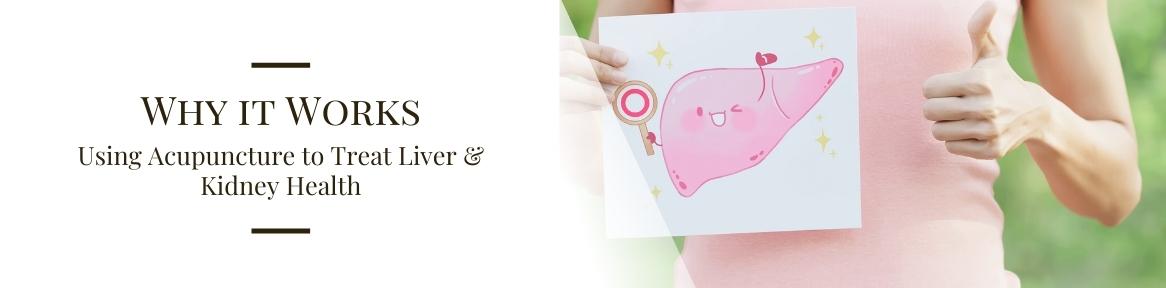
According to the National Institutes of Health, chronic kidney disease (CKD) affects more than 1 in 7 U.S. adults (an estimated 37 million). And the Centers for Disease Control and Prevention estimates that approximately 4.5 million adults have been diagnosed with liver disease. Those are some sobering statistics, but did you know that acupuncture has a proven track record of effectively dealing with kidney and liver disease? continue reading
