
Heart Disease
Chest & Breast Pain & Chinese Herbs

Geography is significant in Chinese medicine. Not just the label of a symptom or disease, but its location, for acupuncturists, strongly informs our diagnosis.
When I ask patients whether they experience chest pain or tightness I am not necessarily concerned for some respiratory or cardiovascular disease. The chest is the “domain of Shao Yang,” “Lesser Yang,” that is relative to the head, neck, and face, described more often in our literature as “Tai Yang” or “Yang Ming,” respectively
The Shao Yang system harbors the end result of our body’s “pivot,” from metabolic production to the distribution of vital substances around the body. Soreness around the ribs, tightness in the chest, cough or even shortness of breath can be a result of our organs failing to produce adequate substances to engender functionality above.
The textbook pulse quality at the radial artery in such patterns is a “wiry one,” illustrating a microcosm of the fluids in our torso beginning to stretch thin. Needless to say, the best way to avoid this mechanism is with a diet that produces ample fluids and exercise to clear heat. If you don’t succeed, and eventually none of us do, what is the flavor of your chest pathology?
Sharp pain that is better with exercise, first of all obviously bodes well from a biomedical perspective, but also indicates some subjective blood stasis in the chest—most often a lack of blood movement due to an inadequate quantity of metabolic fluids giving rise to inflammatory heat, which tends to dry out the diaphragm and everything that includes it. Best remedies are moderate exercise and deep breathing. Best acupuncture points are Pericardium 6, which fires into the brain’s insular cortex, subsequently down the vagus nerve. Herbal formulas include platycodi bark, immature tangerine peel, and peony root.
If the chest feels hot, it suggests further aggravation of inflammatory heat, which might include sequelae such as insomnia, anxiety, and/or irritability. This may be difficult to treat with acupuncture alone, although local points such as Ren 17, Lung 1, and Liver 14 may help. Herbal medicine will be more effective, including the very bitter coptis root or gardenia fruit to additionally clear heat from the stomach, otherwise prunella spike, lily bulb, and/or if there is notable phlegm in the lungs, trichosanthis, or “gua lou pi.”
If your chest pain is worse after eating it clearly suggests some degree of food stagnation—that is indigestion. Steamed and bland foods are advisable until it resolves, as is drinking Pu-Erh tea, and performing manual stomach circles around one’s abdomen.
Best acupuncture points are Large Intestine 4, which fires into the brain’s periaqueductal gray matter, then into the abdomen. Herbal formulas include magnolia bark, rhubarb root, tangerine peel, ginger, and bupleurum root, to comprise the majority of “Da Chai Hu Tang,” or Major Bupleurum Decoction. Alternatively, if one is more prone to diarrhea and lack of appetite, more advisable would be the simple, four-ingredient digestive aid, “Li Zhong Wan,” or Regulate the Middle Decoction, containing ginseng, dry fried ginger, atractylodes root, and licorice.
Persistent chest pain should be taken seriously, especially if coinciding with shortness of breath, and one should see their medical doctor to rule out any danger. Once structural ailments are ruled out come see us to address the root of the issue!
Acupuncture Point for Cardiovascular Health
As someone who comes from a family with cardiovascular issues on both sides it is important for me to be attuned to heart health, not only as a practitioner, but also as a patient.
Unfortunately, as is the case with nearly every condition under the sun, in Chinese medicine there is no one size fits all prophylactic prescription, whether of needle or herb, to prevent cardiac issues. We must due our diligence, understand the full body pattern, and treat every part of it, lest the one neglected will eventually find its way to aggravate the one originally targeted.
Lisinopril is the hypertension medication I see most commonly prescribed, and one of its primary side effects is dizziness. While this is preferable to a heart crisis, it should be understood that this kind of dizziness is exemplary of inadequate blood reaching the head, which means inadequate neurotransmitters reaching the head, which over time may bring with it a whole host of more serious neurological complications.
One way to target support in hypertensive patient and/or those looking to wean off of their medications is to regularly bleed the point, “Lung 5,” or “Cubit Marsh,” located at the crease of the elbow, a bit lateral to the vein we’ve mostly come to know as the blood drawing point.
Why would this work?
First of all, in a lot of people it won’t. Lung 5 is known as the lungs “water point,” partially because its job is to unblock fluid retention in the chest to allow it to descend into the kidneys, then in turn be sent back upwards to calm and help control the heart. If fluid retention in the chest and/or lungs are not present—that is if that is not our etiology—then bleeding this point will likely offer little to no help. Further assessment is required to determine which points and vessels can and should. If fluid retention is present we will likely see dark or distended veins, or spider veins, or fluid amassment in the region of the point around the elbow.
Garlic, ginger, and onions might be advisable. As would Chinese herbs such as Pinella Root.
Another cause for a failure for the lungs to “descend” vital substances into the kidneys is just plain weakness. Call it old age or genetics—whatever floats your boat—but the lungs in this scenario are lacking “qi,” or ample functional gases, to enable them to do their job. In this case we’re more likely to use (“earth”) points such as “Lung 9,” “Great Abyss,” and/or “Heart 7,” “Spirit Gate,” and/or dermatomes on the upper back that correspond to these organ systems.
Lemon water and bitter greens might be advisable. As would Chinese herbs such as Peony Root, Astragalus, Cinnamon, or Schizandra Fruit.
As far as I know, the best ways to prevent heart disease are through regular exercise, stress reduction, and cooked, dark, leafy greens. Beyond that, if it’s in your gene pool and you note congestion at your elbow crease, by all means holler, and I promise to not bleed you out.
Is Coffee Good for the Heart?
I recently read this article from New York Presbyterian on whether caffeine is good for heart health, citing recent scientific research findings that coffee can reduce the risk of heart failure, atrial fibrillation, and type 2 diabetes.
Of course, I have to weigh in… first by thanking NYP for the impetus and content material—even if we come from different paradigms of thought, science, in my opinion, is entitled to nothing if not thoughtful, yet vulnerable debate.
As everyone who adds one, two, or more teaspoons of sugar to their daily coffee knows, coffee is a bitter agent, and in Chinese medicine the directional chemistry of bitter medicines and/or foods is downward—down and out to be specific—evidenced in the bowel movements that are so common after one, two, or more cups of coffee in the morning. Is bitter medicine healthy? Sure, about half the population will gain more physiological benefit than harm from bitter herbs. The other half might experience the short-term benefit of bitters’ ability to reduce local inflammation, but in the long run it may harm their microbiome and ability to absorb nutrients, which in the longer run will create more inflammation.
“Give her more bitters!” the foolish clinician will shout. “Reduce her inflammation!”
But that second time around she is older and weaker—those initially experienced benefits seem inaccessible, and conventional medicine might increase dosages or attempt to potentiate the first medicine’s effect with another anti-inflammatory, and before we know it all gastrointestinal functionality is gone.
According to the FDA about 4 cups of coffee per day is considered safe for most healthy adults. I don’t know about you, but I can say with full confidence if I drank 4 cups of coffee a day for a month, I would develop some kind of health crisis by the end of it.
My opinion is the reason conventional medical research seems to waffle back and forth so much—during one generation coffee’s the villain—next generation it is alcohol—is because of its greatest flaw: Its insistence on attempting to objectify things as healthy or not, good or bad.
Bitter diuretics have a drying effect on the body, so if you are someone who has more pathological biofilms than deficiency of blood and vital enzymes, you may benefit from coffee in moderation. If you are the inverse, it can have the opposite effect. You might mitigate this by having coffee with food, which can provide enough metabolic moisture to offset its bitter diuresis.
A good way to know whether coffee is good for you is to observe how your body responds to it. If it gives you heart palpitations or makes you feel racy, then 2-4 cups per day will likely not benefit your long-term heart health. The same goes for if it causes you soft stool. If coffee is your key to regular, formed bowel movements then its bitter biochemistry likely agrees with you. If it gives you diarrhea it tells us your gut is a bit too lacking in enzymes to properly metabolize it—not to mention the fact that diarrhea further depletes such enzymes, which will inevitably impact the heart over time, ironically.
Many doctors and scientists are brilliant but in my opinion their brilliance is often handicapped by a reductionist lens. If you want to know if coffee is good for your heart one of the best people to ask is yourself. Or a (real) herbalist.
Acupuncture Post-NYC Marathon
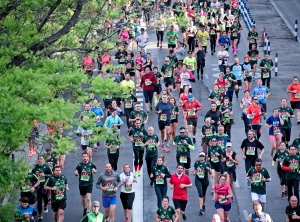
The NYC marathon was this past weekend, and approximately 55,000 people pursued an admirable goal, reached a self-defined mountaintop, and in the process may have caused some degree of irreparable damage to their knees and/or hearts.
Although running is not the most advisable form of exercise in Chinese medicine, it is my opinion that for most people in moderation its benefits outweigh its pitfalls, helping to improve stamina and cardiovascular health, promote circulation, and in most months out of the year a healthy, non-excessive amount of perspiration.
But just like too much perspiration ends up negating its benefit by leaching the anti-inflammatory molecules and neurotransmitters contained within it, too much running can cause more harm than good—excess sweat being just one form of it.
While I struggle to disidentify as anything but a metropolitan, I also know that humans were not intended to walk, let alone run, on cement. That concrete is an inorganic, manmade endeavor, a luxury but challenge of modern society—good for capitalism, bad for Daoism.
Repeated pounding on the knees depletes their synovial fluid, the cushioning between bones and lubrication around tendons and ligaments that keep them soft, pliable, protected. Two ways to mitigate this effect is through stretching, that is opening the vessels and collaterals that send fluids to the patellae, but also with treatment.
Local acupuncture where fluid is missing cannot offer very much, but local moxibustion can inhibit NF-kappa B (inflammatory) signaling pathways, thereby dilating local vessels enough to attract white blood cells and healthy fluids. What’s more, “sports medicine” treatment around the neuromuscular paths that surround the knees can have a similar effect. Rectus femoris, biceps femoris, vastus medialis and laterali—basically, invigorate the thighs to unburden the bones.
As for the heart, this is obviously a serious issue. Excess exercise is arguably just as hard on the body as no exercise. It is important that we all find our own unique sweet spot in the middle and engage with discipline each week. For the excess inflammatory type, who drips with sweat, whose face turns red during workouts, who over-indulges and over-extends, the best recovery formula after a marathon will likely be Bai Hu Jia Ren Shen Tang, or White Tiger and Ginseng Decoction, with gypsum stone to clear the inflammatory heat that can overstimulate the heart, plus ginseng, licorice, and that’s right, white rice, to prevent further heat from flaring.
For the more typical runner type, thin and pale, who gets easily cold and prone to getting sick or injured, a potential recovery formula is Gui Zhi jia Gui Tang, or Cinnamon Twig Decoction with licorice, ginger, red dates, and extra cinnamon to strengthen and warm the chest.
Wishing everyone a speedy recovery, whether from the madness of marathon running or that of trick-or-treating. Stay warm and take care, especially en route to the holidays!
What do Gout, Varicose Veins, & Neuropathy Have in Common?
What do neuropathy, gout, and varicose veins have in common? In western medicine not much, aside from being awful inconveniences, ranging from sources of extreme pain to discomfort and/or a significant cosmetic preoccupation.
For neuropathy you go to the neurologist, for gout to the rheumatologist, and for varicose veins you might see your primary care, who will likely refer you to a vein specialist. The neurologist may or may not inquire about venous circulation, and it is very unlikely the rheumatologist will ask about numbness or tingling in your feet.
But from a Chinese medical perspective, all of these conditions fall under the heading of impaired circulation in the lower extremities, caused by either weakness, inflammation, or both, leading to a misdistribution of bodily fluids, which exacerbates the former, which exacerbates the latter, and so on.
They are different in specifics only as a result of individual genetic proclivities—in fundamental mechanism they are the same. Someone with a colder bodily constitution—prone more to hypothyroid or hypotension, will be more susceptible to varicosities, whereas people with warmer body types—prone more to hyperthyroid or hypertension, will be more susceptible to gouty arthritis. The former are well advised to eat plenty of lamb and red meat, while the latter might consider being mostly vegetarian.
Neuropathies can go either way in the way of temperature, as they are more telling of issues with fluid metabolism. We find that neuropathy patients are either unusually thirsty, unusually not thirsty, or they urinate excessively or not enough. In either case, their body is clearly weakened to some degree, and it is imperative they get to sleep by 11pm, so nerves can properly regenerate.
While inadequate urination obviously leads to fluid retention which can clog neurological pathways and impair circulation, excessive urination can dry vessels of their healthy synovial fluids, causing us to feel parts of our body we previously took for granted as being unaware of.
Holistic medicine should modulate the organ function that is causing the improper excretion of fluids in addition to treating local blockages causing pain or discomfort. Easier said than done of course, as such conditions generally took many years to form, plus might be aggravated by present challenges, such as diet, stress, or medications being used to treat other conditions. However, through a course of treatment of acupuncture, herbal medicines, and dietary modifications, one should see improvement over a proper course of treatment, 120 days.
Please be discerning in your choice of clinician. If you see someone—whether east or west—who is failing to assess or treat beyond the immediate site of pain or discomfort, I would highly recommend getting a second opinion.
