Skip to content

Heel Pain & Autumn Equinox


I recently experienced mild heel pain around the center and edges of my right heel, if not for the first time ever, surely the first in a long time. While one night watching TV last week, I simply needled the “heel point,” located in the center of the base of the palm, just distal from the wrist crease—not one of the body’s more forgiving, gentle points, but tolerable. While the point was in, I rotated my foot and even massaged the heel a bit with my other hand. The next day it was better.

Why needle the hand? And how did this happen, beyond just the lazy etiological platitude of “getting older?”

We are embarking into autumn, the season ruled by the lungs and large intestine. The function of these wonderful organs is to distribute substances downward, quite obviously in the case of the latter, but we also think of the lungs’ function as down bearing, depurative, in distribution of gases and fluids to the lower region of the body—hormonal reserves and essential fluids.

This is why ancient Chinese called the lungs “mother” to the kidneys—the former “engenders” the latter by way of this mechanism of distribution. “Engenderment” in this case might be understood as adrenal and hormonal health’s reliance on ample distribution of fluids and gases from the upper regions of the body. This is why it is important, in my opinion, to consider daily yoga or qi gong routines before resorting to hormone replacement.

What’s more, many of us have also had the experience of having a morning bowel movement on the heels—no pun intended—of morning breathing exercises or yoga, underscoring the inseparable connection between the lungs and intestines along the gut-lung axis.

“The heel point” is not magical. The heels are where the kidney and urinary bladder vessels begin and end respectively, surely highlighting how overworked I may have been, as well as admittedly my own progress along the aging process. When we have heel pain, there is a good chance the lungs are not pulling their weight insofar as distributing anti-inflammatory substances to the bottom of the body. Located at the base of the palm, the point is just lateral to acupuncture’s lung vessel. It acts as a mirror to the heel, not just because of cute bodily holograms, but because the kidneys rely on their mother for circulation.

This “mother son” relationship exists between all our organs and structural parts. For example, pain in the groin exists along the liver vessel, whose mother is the kidneys, which reside in the lower back adjacent to the lumbar vertebrae that innervate the groin! Pain in the knees usually exists along the stomach or pancreatic vessel whose mother is the heart, another organ whose primary function is to distribute blood downward—and the knees can be a long way to travel.

If you or a loved one experiences pain, it’s great to understand it from a musculoskeletal perspective and take care orthopedically, but if you are interested in its root cause, why it happened to land in that place on your body instead of elsewhere, please reach out!

Posted in Allergies, Arthritis, Autumn, Pain Management, Sports injury | Comments Off on Heel Pain & Autumn Equinox

Throwing my Back Out! And Self-Treatment


I’ve arrived, folks. I’ve made it! I am finally “threw-my-back-out-doing-nothing” years old.

One morning last week, I was doing my Qi Gong practice, followed by stretching. I got up off the floor, and I felt my familiar old friend—my right sacroiliac joint—a sprain-like, nerve sensation coupled with soreness, say hello for the first time in years.

In fairness, the stage had been set leading up to this relatively non-expenditure of motion. I’d spent the week before doing an inordinate amount of housework, hosting family staying with us, much more cooking and cleaning, a bit more indulging, not to mention a home’s worth of laundry after my daughter’s Lice sequel, so my body was spent. On the day before I jumped as high as I could on our trampoline and wrestled maniacally with 4-year-olds.

I spent the next morning in pain, obsessively trying to stretch, but to no avail. It was apparently too inflamed, needed first to set in before it could heal, the way it is difficult to resolve a virus in its first 12 hours—that is before it shows itself for what kind of virus it is. By afternoon I could barely walk (unfortunately in parenthood rest is rarely an option). I surely couldn’t lift anything, and wondered if I’d make it to work the next day!


  1. SIMPLICITY & REPETITION: I decided to minimize, to consolidate my rehabilitative routine to just a few reliable stretches, which is important in my opinion, then did them constantly. Some physical therapists make the mistake of assigning 8 or 9 daily exercises, most of which might be beneficial, but if one or two are potentially aggravating, they might keep people on the hamster wheel of suffering, not realizing they could be doing less and getting better.


  1. HERBS: Once in a while we are forced off of our soap boxes and bow in humility in front of that which we resist. I prescribed myself a non-holistic formula—not individualized to my unique pattern—but one simply for inflammation in the low back and lower body. Well worth it short-term, though in fact I did suffer a side effect as a result. While excitatory/warm-natured eucommia bark probably helped my back, it did impact my quality of sleep that night. I cooked it in conjunction with pearl barley, phellodendron bark, and other blood movers to promote circulation in the lower portion of the body, then drank it while my wife warmed up a heating pad for me.


  1. HEAT: As we say in Chinese medicine: “Ice is for dead people”—dead bodies to be exact, but most injuries are not ones of inflammation to the degree of compartment syndrome, which merits ice. Most are minor, protective inflammations surrounded by tight, hypertonic muscles and ligaments that need relaxation, which heat provides.


  1. ACUPUNCTURE: While lying atop my heating pad, I obviously could not needle my own lower back, but I could use “distal points” that connect the spine, ligaments, and erector spinae muscles. I used “Small Intestine 3,” located next to the pinky joint, to treat the spine, “Spirit Bone,” located at the junction of the first and second metacarpals, for its endogenous opioid-releasing effects and connection with the low back’s complementary (lung) vessel; finally “Triple Warmer 9,” atop the forearm near the elbow, also to send blood to its paired vessel. I left the needles in for thirty minutes, basically the duration of a TV show we watched (Wednesday—not thus far recommending), and when I got up to go to bed I was about 25% better. When I woke up the next morning I was 75% better, still having not taken one single, solitary NSAID. No judgement for those that need painkillers, but in my opinion, their side effects should be respected enough to reserve them for times of actual need—pain in times when we need to be active, as opposed to discomfort in times where we can relax.

I should continue to get acupuncture from someone else for this as well. Also, I must do my daily stretches, gradually incorporating more every few days, and probably call it a year on my trampoline wrestling career. I share this story not to brag—though it’s nice to brag—but to reiterate the value of constant and appropriate physical movement and attention towards our ailments. I went from being unable to walk to a full commute and pain-free workday overnight!


Posted in Acupuncture, Arthritis, Back Pain, Dry Needling, ElectroAcupuncture, Pain Management, Sports injury | Comments Off on Throwing my Back Out! And Self-Treatment

How to Combat the Humidity

Nobody loves humidity, but many people are more perturbed by it than others, determinable of course by what the humidity is encountering at their surface—that is, what it is physically triggering for them.

Humidity is “damp heat,” so if you already suffer from an excess of systemic damp heat type inflammation at the surface of the body, pouring more of the same on top of that will surely feel awful. What can we do about it?

Nutritionally the ideal foods to combat the damp heat of summer are unfortunately not very fun or exciting, but let’s try to all be grown-ups.

Bitter foods like dandelion greens are great for clearing inflammatory heat, while bland foods, such as unseasoned (or very mildly seasoned) potatoes, barley or barley tea, and plain, steamed vegetables are ideal for leaching damp fluid retention. If this sounds too inconceivable for you, I’d recommend entertaining such discipline just once a day.

Additionally, the bitterness of a good quality, hot green tea and its diuretic effect an aid in draining dampness. Then again, if green tea is unsettling for your stomach you are probably too “cold” for it internally, which unfortunately is not mutually exclusive to having damp heat externally. The former refers to pancreatic and gastrointestinal hypofunction, whereas the latter is part of the inflammation as its logical outcome. See also, eczema due to food allergy.

Instead of over-complicating, over-analyzing, and arguably over-prescribing, all of which I have been more than prone to, for this time of year I recommend at the least “dui yao” (dway-yow) teas, or pairings of 2 simple herbs to drink daily to combat the humidity we’re experiencing, mitigate our unique genetic responses to it, and ensure as productive digestion as possible for the upcoming transition to Fall, when we need our immune system firing on all cylinders!

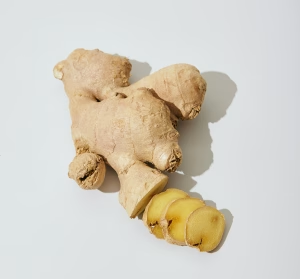
Examples: Pearl barley and raw ginger if you have a weak stomach, Pearl barley and red dates if you get heart palpitations or dizziness or are on your cycle, Pearl barley and tangerine peel for lack of appetite, or pearl barley and adzuki bean for hemorrhoids, sweaty feet and groin. Are you seeing a trend? This is barley season!

What are everyone’s favorite cinematic depictions of gut-wrenching NYC summer humidity? I vote Do the Right Thing and Weekend at Bernie’s

Posted in Acupuncture, Diet, Herbal Medicine, Holistic Health, Nutrition, Self-Care, Traditional Chinese Medicine | Comments Off on How to Combat the Humidity

Slow & Steady Heals the Shoulder

At the end of 2022 I tore my rotator cuff, not throwing a baseball for some important league game, not in some random construction accident nor act of heroism. Instead, one of my first favorite paternal pastimes was throwing my daughter as high as I could into the air then allowing her to crash down on to my palm, elbows flexed, held tight by my bicep’s insertion.


Everyone says the same thing: You blink and they’re all grown up! This isn’t exactly an example of that, but I definitely didn’t take adequate note that my favorite play toy had grown from 15 to 25 pounds, and as an acupuncture colleague who was treating me for the issue remarked: “Would you throw a 25-pound weight up and down and catch it in your palm?”


To which I replied: “It depends how adorable and joyful the weight was.”


Typical presentation of a torn supra-spinatous: Pain radiating into my deltoid, especially with my arm extended to the side and/or behind me—even worse with inward rotation (trying to pour water from pitcher into our filtration system). Occasional pain while lying on my shoulder at night, and I couldn’t throw a tennis ball, let alone a baby anymore. I had to find other ways to enjoy parenthood. I also got used to pouring water with my left arm, which was probably a temporarily decent brain exercise anyway.


My funny acupuncturist friend helped a bit—a lot of sports medicine, trigger points and gua sha techniques—though no classical points, and improvement was always temporary. For two years my intermittent, moderate pain continued, and I was terrified of the notion of surgery and determined as such to avoid it.


I continued to go for treatment, occasionally poked and cupped myself at home as much as I could (though the supraspinatous is located behind the shoulder, making local self-treatment relatively impossible), and got very diligent with my daily Qi Gong practice: Shoulder rotations, shoulder rolls, neck rolls and rotations, “silk reeling” exercises, which are great for creating unique notches of negative space around the joints for the corresponding breathwork’s oxygen to enter. “Qi moves the blood,” is one of our most ancient maxims, which means where oxygen goes, fluids follow. I couldn’t tell you when it happened any more than I could when my daughter jumped from 15 to 25 pounds, but somewhere between years 2 and 3 of my injury, enough fluids got to the tendon and joint for my pain to disappear!


Today I am unsure if the tear is still there—I’m 47, not 27, so my shoulder may never again be perfect. I continue to do my Qi Gong regularly, preventively, not only for my shoulder, but other vulnerable tendons and ligaments as well. Slow and steady heals the shoulder!


If you have chronic pain it is something that requires daily attention, an at home regiment, self-massage and gentle movement anywhere from 10-20 minutes 1-2 times a day, and patience, the “patient patient,” if you will. If you stop, if you half-ass it, or give up, you’ll likely be resigned to the “blue pill,” surgery and well… literal blue pills, either of which will eventually wear off. I often recommend tailored Qi Gong homework exercises to my patients with our sessions, but if you’d like local Qi Gong teacher referrals, please let me know—happy to refer!

Posted in Acupuncture, Arthritis, Dry Needling, ElectroAcupuncture, Pain, Pain Management, Sports injury | Comments Off on Slow & Steady Heals the Shoulder

Yin & Yang of Stomach Pang!

Not all bellies are created equal, nor therefore, is all belly pain.

Stomach pain on the left tends to have more to do with organ function, whereas (in women) the left side might pertain more to ovarian function. Generally, belly pain that occurs above the umbilicus pertains to two of the three “yang” systems of the body, either “Shao Yang” or “Yang Ming,” either of which because of their connection to our intestines and digestive enzymes, might be accompanied by thirst for cold drinks, insomnia or agitation (not only as a result of the stomach pain), constipation, chest tightness, blurred vision, or blockage of the ears.

“Yang stomach pain,” as it were, tends to be constant—the abdomen feels firm and hard, resistant to touch. Conversely, pain that occurs below the umbilicus pertains to any one of the three “yin” systems of the body—gastrointestinal, endocrine, and/or hematological, tends to be more intermittent. The abdomen is softer, still tender to the touch, but it occurs more often in people who are prone to diarrhea and sensitive to the cold.

Thirst may still be present, though it is more likely for small sips of warm water, not big gulps of cold. That is because thirst of yin pathologies is a result of the GI tract’s lack of healthy fluids, whereas thirst of yang pathologies is from excessive inflammatory heat. If the same medicine is prescribed to both patients, one will improve and the other will exacerbate.

Yang pathologies might find relief with sour and/or bitter foods and medicinal—those whose mechanism is to drain, purge, and emolliate the abdomen.

Yin pathologies might find relief with sweeter (not by American standards) and more acrid (not by Indian standards) foods—those whose mechanism is to imbue the organs with more energy.

Another great way to distinguish diagnosis is by learning how people find relief.

If passing gas provides relief it is more likely a yang pathology, whereas if a complete bowel movement is needed it is more likely yin. If a hot compress feels good this is DEFINITELY a yin pathology, just as if ice water does it is DEFINITELY yang. A patient suffering from gastrointestinal, hormonal, or hematological weakness wouldn’t wish ice water on their worst enemy! That’s probably not true. People suffering with chronic “yin pathologies” tend to be understandably irritable, henceforth would very likely wish this on their enemies.

Then again, wouldn’t you wish acupuncture on your worst enemy, to transform them into a healthier, happier person to ultimately convert from worst enemy to best friend, or at the least, tolerable human being?

Where is your stomach pain, or that of a loved one?

What makes it better?

What makes it worse?

The answers to these questions and more can help us ascertain an accurate pattern diagnosis!

Posted in Digestive Disorders, Herbal Medicine, Pain, Weight Loss | Comments Off on Yin & Yang of Stomach Pang!
646-242-7621 Directions Contact/Schedule