
Holistic Health
K-Pop Demon Hunters Laryngitis Cure
 If you have a daughter between the age of 4-7 there’s a good chance you’ve seen the 2026 Academy Award winning movie, K-Pop Demon Hunters. I’ve seen (part of) it many times.
For those who haven’t, it’s about a group of adorable, young, female K-Pop stars—by all appearances as big and famous as Taylor Swift—whose side gig is to periodically battle and destroy a species of underworld demons. I like to joke to my wife to imagine if Taylor or Beyonce moonlighted as fierce, violent warriors. Childhood is fantastic.
The hook is that the group’s lead, Rumi, is secretly half-demon. As a result, parts of her body are covered in constitutional skin patterns that she shamefully conceals from her best friends and the world. Early in the movie, near the peak of her success (which somehow promises to help finally eradicate the demon realm) she begins to intermittently experience bouts of laryngitis that are supposedly due to her heritage—not her career. As outlined by Mayo Clinic, this is an extremely common symptom and challenge for singers, most of whom have no demon blood. Desperate for a resolution, her friend and bandmate, Zoe, refers her to a local “healer” in town.
I have been an acupuncturist and Chinese medicine clinician in New York for thirteen years. Herbal medicine is a huge part of my practice. I teach it at Pacific College of Health and Sciences and Virginia University of Integrative Medicine, and study Chinese medical texts every night. However, I frequently feel like the polarizing charge around the Covid vaccine during the pandemic has, in the minds of the “science is real” crowd, given us a bad, or at least an inadequate rap.
The local “healer” Rumi goes to ends up personifying many modern stereotypes about alternative medicine. His personality is kooky. On one hand, he can accurately “see through” each of Rumi’s friends, Mira and Zoe, into their souls, and tell them things about themselves they were barely aware of. On the other hand, he turns out to be a charlatan when they later peel away the label from the herbal potion he gives Rumi, revealing it to be grape juice.
I was fine with the idea of Taylor Swift and Beyonce working days as demon slayers, even with the proposed etiology of Rumi’s laryngitis being her demon heritage, as opposed to the more scientifically logical one of being a singer. But I must take exception to us (Eastern) herbalists being consistently portrayed as quacks—not to mention a contradictory one in this case, where said charlatan concurrently possesses a very impressive psychic intuition.
Chinese medicine is not inherently opposed to western medicine. Many generations ago, Chinese medicine doctors once crushed up smallpox scabs to then blow up the noses of people with the intention of inoculation. Most Chinese hospitals of our present generation contain and administer both western pharmaceuticals and Chinese herbs equally, sans contentious ego, depending on what they deem the best option for a patient. I’m confident if any layperson or doctor were to read the medical texts I do or listen to the scholars I do, they would see that those of us who study diligently think every bit as critically as MD’s—that the majority of us are neither frauds nor “insta-famous,” and we can diagnose as well as any internal paradigm.
For what it’s worth, if Rumi’s voice problems were due more to her professional career, Chinese medicine has a lot to offer.
Our throats and voices derive functional fluids from our stomachs, which means singers are logically prone to dehydrating the digestive enzymes and healthy mucosal fluids of their microbiome. There are many ways to approach, depending on each patient’s unique body type.
If they are prone to general weakness and/or being thirsty for warm drinks Chinese or American ginseng can help. If they tend to low blood pressure and these same symptoms one might consider high doses of licorice, prepared with honey if they tend to feel more sensitive to cold, unprepared if more sensitive to heat. If they tend to nausea, sinus congestion, and/or a lack of thirst for water, pinellia root may help. If there is pain in the chest and phlegm in the throat, platycodi root can. There is also a classical formula from the Han Dynasty, “Jie Geng Tang,” which contains platycodi and licorice, a presentation no doubt combining phlegm trapped in the chest preventing functional fluids from reaching the throat.
Rumi would also be well advised to minimize the kimchi, as from a Chinese medical perspective both raw and spicy foods may cause vasoconstriction in the throat, the latter of which additionally dries out stomach fluids. Conversely, she should double down on the ramen and white rice, as “geng mi,” or rice can help generate stomach fluids.
I have no knowledge of herbal medicine or acupuncture reversing demon blood, but we can absolutely treat laryngitis, pharyngitis, and a whole host of chronic internal conditions. I am yet to meet a colleague with true psychic powers who can see through to patients’ souls, nor to know one who attempts to pass of grape juice as medicine.
In-Person Herbology Class, NYC

I am humbled and excited to have been invited to teach my first live, in-person class next week for NYC Acupuncture School on the correspondence between particular pulse “qualities” at any of the six—that’s right 6—pulse positions along the radial artery of each wrist. That’s a grand total of twelve pulse positions if ever you’re wondering why I’m sitting there for so long with three fingers along your radius.
Directionality is everything in Chinese medicine, and specific herbal medicines and the formulas they command, induce physiological responses, which, put simply, have either excitatory or inhibitory, restorative or draining effects on the body.
When a certain herb (or supplement) is considered to stimulate immune function what it means is that it directs (immunological) molecules upwards, both vertically towards our sinuses and upwards to our dermatological surface. For about half the population, whose physiological pattern requires more upward movement, these medicinals should support their immune function. For the other half, including myself, who need more downward movement, this will do more harm than good. In holistic medicine we have the gift of pulse diagnosis to determine who is who and what is right.
The pulse for astragalus for example would be weak and/or “hollow” at the first and second positions on the right wrist. Why?
These positions correspond to the lungs and stomach—the respiratory and gastrointestinal microbiomes, respectively—and their inter-connection revolving around immune function. If the arteries here feel constricted and tight this indicates cold-natured inflammation in the region, which astragalus will do nothing for. If the arteries feel strong and congested this might indicate “hot-natured” inflammation, which astragalus will equally do nothing for—in fact in this case, would probably hamper immune optimization. Only a small, weakened artery in this position informs us that it is appropriate to use a medicine that will generate fluids in the gut and ship them outward to the exterior. This same mechanism applies to many people who experience spontaneous sweating, yellow or sticky sweat, or joint pains.
There are countless other examples like this in Chinese medicine’s pharmacopeia and diagnostic process that aid us towards being increasingly more specific and effective holistic clinicians. While it helps to still do our due diligence, asking the appropriate questions, inspecting each patient’s tongue and abdomen, my present understanding is no diagnostic tool is more reliable than the feeling of the radial artery.
When someone misses a shot in basketball trash talkers on the opposing team often say: “Ball don’t lie.” In Chinese medicine we say—well, I say: “Pulse don’t lie.”
Obviously, this event will be of greatest interest to students and practitioners, but anyone wishing to become a more educated patient around the workings of their body is welcome!
Spring Scholarship for Free Acupuncture!
 It’s that time again! As the winter term comes to a close, a friendly reminder of my quarterly offer of free weekly acupuncture sessions to any one patient who cannot otherwise afford treatment. Please let me know if you, a friend, or family member would be a good candidate to allow me to give back.
As always, stipulations include a relative lack of resources (on the honor system), plus an ability to come on Fridays in the late morning or early afternoon when I have more office space available.
I have been fortunate enough to have a patient base that is generally kind, complimentary, and forgiving of my shortcomings, but I’d also like to take this opportunity to request any constructive criticism or feedback on either my space or treatments. Even if it is something seemingly menial, such as pillow comfort or temperature in the treatment room, if you’ve thought it somebody else probably has as well, and all parties would benefit from your honesty. As clinicians, I believe it is as important to accept such reporting as it is to remain true to our fundamental philosophy and approach.
Happy upcoming spring solstice! If you have trouble waking up in the morning, ’tis the season for acrid and spicier foods to encourage the seasonally organic upward movement of blood and neuro-chemicals. If you tend to wake up too early or feel generally over-stimulated ’tis the season for more sweet foods, such as steak and rice, to mitigate their surge. Refined sugar also works in the short-term, but obviously leaves inflammation in its wake, which leads to perpetually more aggravated surges, henceforth more dependency on sugar!
My favorite bit from James Clear this week:
“The modern world is optimized for convenience, not improvement.
The default path is usually the more convenient path. And I get it. Who wants their days to be a pain in the neck? I like sitting in air-conditioned rooms and watching my favorite shows too.
But the body and mind only grow when placed under a stimulus. If you want improvement, you have to choose something different than convenience.
It can be lovely to have a day where you do not push yourself, but it rarely works out well if you have a life where you do not push yourself.”
How to Combat the Humidity
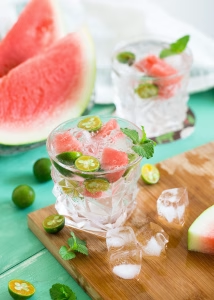
Nobody loves humidity, but many people are more perturbed by it than others, determinable of course by what the humidity is encountering at their surface—that is, what it is physically triggering for them.
Humidity is “damp heat,” so if you already suffer from an excess of systemic damp heat type inflammation at the surface of the body, pouring more of the same on top of that will surely feel awful. What can we do about it?
Nutritionally the ideal foods to combat the damp heat of summer are unfortunately not very fun or exciting, but let’s try to all be grown-ups.
Bitter foods like dandelion greens are great for clearing inflammatory heat, while bland foods, such as unseasoned (or very mildly seasoned) potatoes, barley or barley tea, and plain, steamed vegetables are ideal for leaching damp fluid retention. If this sounds too inconceivable for you, I’d recommend entertaining such discipline just once a day.
Additionally, the bitterness of a good quality, hot green tea and its diuretic effect an aid in draining dampness. Then again, if green tea is unsettling for your stomach you are probably too “cold” for it internally, which unfortunately is not mutually exclusive to having damp heat externally. The former refers to pancreatic and gastrointestinal hypofunction, whereas the latter is part of the inflammation as its logical outcome. See also, eczema due to food allergy.
Instead of over-complicating, over-analyzing, and arguably over-prescribing, all of which I have been more than prone to, for this time of year I recommend at the least “dui yao” (dway-yow) teas, or pairings of 2 simple herbs to drink daily to combat the humidity we’re experiencing, mitigate our unique genetic responses to it, and ensure as productive digestion as possible for the upcoming transition to Fall, when we need our immune system firing on all cylinders!
Examples: Pearl barley and raw ginger if you have a weak stomach, Pearl barley and red dates if you get heart palpitations or dizziness or are on your cycle, Pearl barley and tangerine peel for lack of appetite, or pearl barley and adzuki bean for hemorrhoids, sweaty feet and groin. Are you seeing a trend? This is barley season!
What are everyone’s favorite cinematic depictions of gut-wrenching NYC summer humidity? I vote Do the Right Thing and Weekend at Bernie’s
Transitioning from Summer to Fall

Although it remains deftly hot and humid, according to the traditional calendar and evidenced in the shorter days and longer nights, we now find ourselves in the transition between summer to autumn.
Summer corresponds with the heart and central nervous system, autumn with the lungs and immunity, but each quarterly transition of the seasons corresponds with the gut and microbiome, thereby further underscoring the importance of digestion in engendering all other organ systems. This one might be most directly significant, as in Chinese medicine’s cycle of the five elements earth is “mother to” metal, which is to say the stomach is primarily connected to pulmonary health. Anyone who’s ever suffered with an asthma attack due to dairy consumption or sleep apnea due to a weight problem can attest.
To compile the challenges posed by American diets and grocery options, we are simultaneously confronted with the humidity, which might further aggravate pre-existing dampness in one’s gut, depending on their constitution, diet, and body type. As always, I recommend going gluten, dairy, sugar, and alcohol free as much as possible.
To avoid gluten, there is always rice or great gluten free pasta brands now, such as Glutiniete. To avoid dairy, you can occasionally sprinkle nutritional yeast on foods and/or make vegan parmesan cheese with this simple recipe:
To avoid sugar I recommend increasing your tolerance for dark chocolates, and/or eating spoonfuls of nut butters with a touch of maple syrup or honey. If you must have alcohol, then vodka, tequila, mezcal, and organic wines are preferable. People often forget (especially when seeking a buzz) that grapes are always on the dirty dozen list, which means their inorganic versions are ridden with pesticides.
Those are a lot of DONT’s, I realize. As for DO’s:
- Eat a warm breakfast with protein: Eggs, oatmeals, congees, etc.
- Sweet potato, sweet potato, sweet potato! An excellent digestive aid and coming into season in fall. I like to roast them either with salt, pepper, and garlic, or cinnamon and maple syrup. For the latter I add sliced apples for my toddler in the last 15 minutes.
- Small amounts of fermented pickled foods, such as kimchi, sauerkraut, or pickles for their naturally occurring probiotics.
- Pu-Erh tea instead of green in the morning, also for its naturally occurring fermentation. Green tea, even when consumed hot, has a cold quality that can harm weak stomachs.
- Hot ginger, licorice, and/or barley tea in the evenings.
Finally, in our classical texts it is said that excessive standing harms the kidneys, excessive celebration harms the heart, and excessive sitting harms the stomach. What is meant by the latter is something the ancient Chinese understood and has only in recent generations become common knowledge in the west: sedentary lifestyles compromise metabolism. No matter how well we eat, it won’t much matter if we never get up and move.
