
Digestive Disorders
Mitigating the Side Effects Of Holiday Indulging
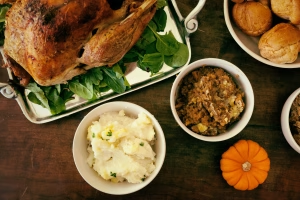
As all of our stomachs, intestines, livers, and pancreases quiver in fear, anticipating the overindulgences to come in the next six weeks, there are steps we can take to mitigate their onslaught of abuse, first and foremost of which is to potentially be mindful to not over-abuse—an unrealistic request for enough of us! So, what OTHER MEASURES can we take?
- Strength training: By making good use of the excess proteins and calories we can getbigger and badder musculature, and since the muscles draw upon the pancreas and stomach for tonification, strength-training provides the additional benefit of putting less burden on these organs, enabling them to better deal with the burden of parties.
- Hot tea: Booze if you must leading up to, during, and even after the meal, but bookmark your gluttony with hot tea—either Pu-Erh, which contains naturally occurring pro-biotics, or whichever flavor floats the boat. Hot tea will dilate and relax the blood vessels of your enteric nervous system (belly) which aids in digestion by breaking down the inevitable accumulations of gravy, yams, and butter.
- Breakfast! Some people make the mistake of skipping breakfast (or even lunch) the morning of Thanksgiving to “make room” for the feast to come. This is an error, as skipping breakfast actually sacrifices some of the gut’s enzymes and beneficial acids, which can make digesting the feast more difficult. Fine if you want to go small, but have something, preferably, oatmeal, millet congee, or eggs and vegetables.
- Stress management: The holidays bring at least one challenging individual into our homes, so in the words of my daughter’s favorite song: “Let it go.” Ignore if possible, just for the day, and re-address if you must the next time you speak to them.
- CHINESE HERBS! Last but not least, YOU GUESSED IT! Commonly used ingredients include hawthorn berry, which can lower cholestrol, magnolia bark if you’re the type who feels gassy and stuffiness in the chest, tangerine peel if you feel too low on appetite to get properly gluttonous, obviously ginger and licorice, the latter if you tend to GERD, also barley sprouts or medicated leaven, which are great for food stagnation.
If you’d like a brief consultation to determine what is the best gluttony-support formulation for your body type and indulgence to come, please don’t hesitate. If not for my own gout disease and general health awareness, I myself would have the inclination to over-indulge frequently, regardless of holiday season.
A brief expression of gratitude. I realize that Chinese medicine is inconvenient. It’s expensive, it tastes bad or it hurts for a moment, it takes time out of the day, etc. etc. I am grateful to all of my patients for trusting me, relying upon me, and staying the course, often through the trial-and-error process that in my opinion real medicine should look like. Happy Thanksgiving!
Halloween: from a Chinese Medical View
 FEAR, in Chinese medicine, is said to harm the kidneys, a mechanism that is easily relatable and biomedically translatable in that when scared, our brains signal to our adrenal glands to release cortisol and adrenaline, which in turn subjectively exhausts our hormonal reserves, or the Chinese concept of healthy blood and fluids.
This blood and fluids are necessary to attract our excitatory hormones and neurotransmitters back downwards so they can do things like transform fluids and allow us to sleep and relax. As they deplete, with age, stress, and self-destruction, we become more prone to more easily releasing cortisol, which perpetuates the vicious cycle. Eventually we run out of cortisol, adrenaline, as well as our fluids that fall under the concept of “blood,” and we die, buried in the ground like the ghouls, goblins, ghosts, and skeletons that started this whole problem in the first place!
CANDY, in Chinese medicine, is said to harm the spleen, which really just means it destroys our digestive system—the system whose job it is to produce the blood and reserves that are necessary to mitigate the side effects of adrenal and cortisol spikes that are relatively unavoidable in modern life. I’ve had many patients who grew up in foreign countries relate to me that while they had plenty of sweets and treats as kids growing up, nothing was as saccharin sweet as what they tasted upon arriving in the U.S.
While it’s nice to be nice to ourselves, forgiving and all that, I believe packaged junk food that really doesn’t expire should be invisible to us if we wish to have any hope for long term health. My wife and I unapologetically shelter our daughter from it as much as possible for as long as possible to give her organs as much time to develop sans the perversion of corporate crap.
With that said… the reason many of us experience sweet cravings when stressed is because cortisol and adrenalin are up, therefore blood and fluids are down, and what substance to better mimic the mush of mucosal fluids than SWEETS? The ancient Chinese used (relatively) sweet flavor herbs, such as red dates, licorice, and rehmannia to “calm the liver”—that is to mitigate hyper-reactions of adrenaline.
SO IT MAKES SENSE! THE LOGIC OF HALLOWEEN IS CONSISTENT WITH THAT OF DAOIST BIOLOGICAL PRINCIPLES! Go out, get scared, have fun, then come home and enjoy a few treats 🙂 Discard or donate the rest. Ignore candy and forget about treats for the rest of the year, or at least until Christmas, for God’s sake, and use healthier options to reattract your stressed floating “yang qi” downwards:
- Nut butters like from Fixx and Fogg
- Dark chocolates like from Blue Stripes
- Coconut yogurts maybe with red dates, goji berries, and/or maple syrup, and/or nut butters with dark chocolate… ANYTHING besides refined junk food, please.
Just as “fear harms the kidneys,” excess anger is said to harm the liver, grief does the lungs, and worry harms digestion as much, if not more than poor diet. None of us, myself included, will ever be immune to worry (no vaccine for that (yet)!), so friendly reminder to have a context of friends, spiritual practice, and/or spiritual community to lean on.
Happy Halloween!
What Fall Flavor Are You?
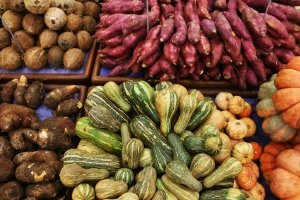
The brilliant rationale behind why the ancient Chinese associated certain seasons of the year with certain organs, then certain organs with flavors of foods (and herbs), had to do with the organic physiological responses to temperature and climate, how they align with each bodily system, and the biochemical reactions incited by each flavor in the body. For example:
Acrid goes up and out. Haven’t we all had the experience of sweating or decongesting after spicy food? Bitter goes down and out. Most have also had the experience of drinking coffee or green tea, then having to go to the bathroom. Sour goes down and in, as does sweet, whereas salty goes down and in, but brings enough water into our cells to then vaporize upwards, which is why its mechanism can RAISE blood pressure.
Unfortunately, in (Traditional) Chinese medical schools, due to modern misinterpretations of the medicine we are lucky if we’re taught half-truths of fact—too often we were told objective untruths—though regarding flavors and seasons we at least got the former.
We were taught that the acrid flavor corresponds with the lungs, which correspond with fall, though this is only one of fall’s flavors, and arguably the less significant one, nor was it ever really explained WHY the lungs correspond with autumn.
Fall is nature’s regression and recession, just as the days grow shorter and animals begin their hibernations, gases and blood in the human body sink deeper, as in towards our adrenal glands, where we can reproduce ample hormones and healthy blood to then rise again in spring. The chemical mechanism induced by acrid foods or herbs DOES NOT encourage this movement. So, while less educated practitioners uniformly advise everyone to eat more onions, garlic, and ginger during fall, recall there should never be any one size fits recommendations in (holistic) medicine or nutrition.
Because the chemistry of acridity moves things upward and out in the body it is surely useful for dislodging the phlegm and mucus often accumulated during allergy, flu, and covid season. It can also be useful for patients who find that during autumn and/or year-round, they have a remarkable difficulty with all kinds of rising—whether out of bed in the morning, off the couch to exercise, intellectually, or in sexual engagement.
For the other half of the population, the more calming, descending mechanism of sour is more logical. Especially since along with bitter, another “flavor of descent,” sour is one the more unrepresented ones in most American diets, maybe partially explaining why modern Americans have so much difficulty with grounding, sleeping, and slowing down.
To understand which flavor should dominate your diet and herbal formulas this season, you can try feeling the (second/middle finger) “guan” pulse position on your left wrist. If the artery feels small or weak your body needs acridity! But if it feels big, inflamed, angry, you need LEMONS 🙂 When life gives you lemons, first feel your pulse. Or get your acupuncturist to do it.
As for nature and safer one size fits all advice: ‘tis the season of root vegetables, so cook plenty of carrots, radishes, beets, yams, and brussels sprouts. In fact, a perfect way to roast the latter is with garlic, onions, and lemon (+salt and olive oil), thereby getting the best of both worlds. Really in my house I should separate them on the pan and take the lemon part for myself and allot all acridity for my wife! But who has the time? I’ll just drink my sour herbs.
Yin & Yang of Stomach Pang!

Not all bellies are created equal, nor therefore, is all belly pain.
Stomach pain on the left tends to have more to do with organ function, whereas (in women) the left side might pertain more to ovarian function. Generally, belly pain that occurs above the umbilicus pertains to two of the three “yang” systems of the body, either “Shao Yang” or “Yang Ming,” either of which because of their connection to our intestines and digestive enzymes, might be accompanied by thirst for cold drinks, insomnia or agitation (not only as a result of the stomach pain), constipation, chest tightness, blurred vision, or blockage of the ears.
“Yang stomach pain,” as it were, tends to be constant—the abdomen feels firm and hard, resistant to touch. Conversely, pain that occurs below the umbilicus pertains to any one of the three “yin” systems of the body—gastrointestinal, endocrine, and/or hematological, tends to be more intermittent. The abdomen is softer, still tender to the touch, but it occurs more often in people who are prone to diarrhea and sensitive to the cold.
Thirst may still be present, though it is more likely for small sips of warm water, not big gulps of cold. That is because thirst of yin pathologies is a result of the GI tract’s lack of healthy fluids, whereas thirst of yang pathologies is from excessive inflammatory heat. If the same medicine is prescribed to both patients, one will improve and the other will exacerbate.
Yang pathologies might find relief with sour and/or bitter foods and medicinal—those whose mechanism is to drain, purge, and emolliate the abdomen.
Yin pathologies might find relief with sweeter (not by American standards) and more acrid (not by Indian standards) foods—those whose mechanism is to imbue the organs with more energy.
Another great way to distinguish diagnosis is by learning how people find relief.
If passing gas provides relief it is more likely a yang pathology, whereas if a complete bowel movement is needed it is more likely yin. If a hot compress feels good this is DEFINITELY a yin pathology, just as if ice water does it is DEFINITELY yang. A patient suffering from gastrointestinal, hormonal, or hematological weakness wouldn’t wish ice water on their worst enemy! That’s probably not true. People suffering with chronic “yin pathologies” tend to be understandably irritable, henceforth would very likely wish this on their enemies.
Then again, wouldn’t you wish acupuncture on your worst enemy, to transform them into a healthier, happier person to ultimately convert from worst enemy to best friend, or at the least, tolerable human being?
Where is your stomach pain, or that of a loved one?
What makes it better?
What makes it worse?
The answers to these questions and more can help us ascertain an accurate pattern diagnosis!
What Should We Be Drinking?
 How much water should we be drinking? Is cold water okay? Is coffee healthy or not, already? What about decaf? What about green tea? Green juices? Prune juices? Sparkling water??? Please tell me sparkling water is OK! It’s all I’ve got…
Across the generations (and mediums) there have been many hydration gurus, and I suppose in this blog I’m throwing my hat into the ring, albeit really as just a hopefully qualified echo of Chinese medicine’s biological perspective.
Sparkling water is OK, but can irritate the bladder—should be kept to 1/day.
Room temp water is best, ideally half of our weight in ounces each day. Cold drinks can impair digestion, but again, once a day outside the context of a meal is no big deal, imo.
Juice is worse than people think—green juice not quite as good as people think. Green juices, without the sugars of fruit inside them, are fine, but should not replace real meals where salivary amylase is generated, we actually eat, and chew whole (green) vegetables.
One coffee/day should be fine for most people, but obviously has an excitatory and diuretic effect, so if one suffers with a lot of heat or dryness symptoms, should be minimized. These can include everything from insomnia and irritability to bloating or lack of appetite (dryness of digestive enzymes).
Green tea is preferable in people with “heat patterns,” and/or after a night of eating red meat, which can generate heat in the intestines. Again, because of its bitterness, people who tend to nausea, diarrhea, or lack of appetite should steer clear of green tea, and reach instead for…
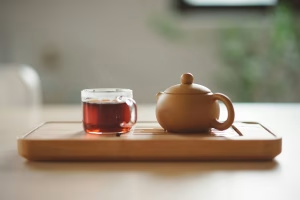
PU-ERH TEA! Probably the healthiest thing one can drink besides clean, room temperature water, pu-erh is a black tea known for its naturally occurring pre and probiotics that enhance digestive and gut barrier function, the latter of which gets compromised by stress, medications, or alcohol. And I don’t know anyone who doesn’t check off at least one of these. Best taken hot.
I try to limit myself to 2 caffeinated beverages/day (I think no one should have more than 3), which are routinely a cup of Purity black coffee, followed by a cup of pu-erh, from either ARBOR or YUNNAN SOURCING, both of which offer organic and fair trade, high quality products. Highly recommend!
