
Allergies
Herbal Profile: Chi Xiao Dou (Adzuki Beans)!
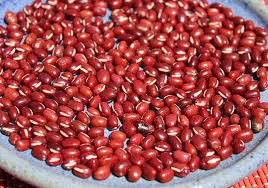 In Mexico black or refried beans are most popular. Caribbeans eat black peas, Indians more lentils, and of course Americans prefer the sweetest of all, baked beans. In China though, adzuki beans are more than just a delicacy—they are an important ingredient in our classical pharmacopeia, often used to treat conditions of the intestines or skin, the latter frequently manifesting pathologies of the former, thereby informing us of the underlying pattern.
For example, while redness around the forehead points to suspected biofilms of the intestines, acne that falls more around the jawline, chest, or upper back suggests biofilms of the stomach. Chi Xiao Dou, or Adzuki Bean, can be used to treat either, provided it is appropriately dosed within the context of an accurate holistic formula. It is also useful for eliminating or minimizing liver spots, pus accumulation around the eyes, and other random skin discolorations.
Listed in our texts as sweet, sour, and neutral in properties, its neutrality allows it to diffuse dampness in the body that is either cold/inhibitory or hot/excitatory in nature. Its sweetness encourages the body to generate a healthy amount of fluids, and its astringency obviously helps our body to hold that which is leaking, or sinking. It is said to gently promote blood circulation between the bowels and the skin layer.
This might explain why it comprises half of the formula, Dang Gui Chi Xiao Dou Tang, most commonly prescribed to treat certain types of hemorrhoids and skin issues around the buttocks.
If the shoe doesn’t fit—that is if this formula does not fit your pattern, but you still suffer with chronic hemorrhoids, it is advisable to regularly consume adzuki beans with your meals to take advantage of its biofilm dissolving properties. By relieving intestinal vessels of inflammation this should take pressure off of the rectum.
Adzuki beans go well with rice and/or Latin or Asian dishes, also within rice congees plus a boiled egg, providing additional protein to an otherwise dish of just white rice. If you don’t love the taste as much you can also do what I do for my daughter, which is mix the adzuki beans with baked beans as a side dish on hamburger and hotdog nights.
To treat skin conditions Chi Xiao Dou is generally paired one way or the other:
- With the aforementioned, Dang Gui to not only help to generate red and white blood cells, but also to courier them to the surface to nourish and lubricate the skin.
- With more bitter, inhibitory, heat clearing medicinals, such as rehmannia root to mitigate the body’s inflammatory response, known to flare upwards in the form of jawline or upper back acne (“Backnee”).
If you think adzuki beans might help you or a loved one reach out—or just go to the store, purchase, and cook them up! Preferably organic, as inorganic legumes can be particularly vulnerable to chemicals and pesticides. Any recipe or preparation questions, let me know!
Alternative Acne Treatments
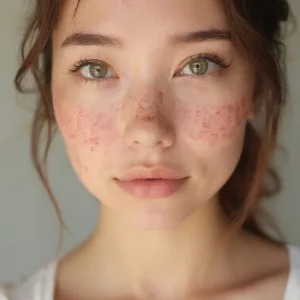 Acne has many faces. Why does it land on us? Our faces and backs, upper or lower back? Why for some of us is it itchy, while not for others? For some it is painful. Some women get flares on their cycle, or just after. Why?
The Jue Yin-Yang Ming mechanism is one of the most important connections in Chinese medicine. It dictates that our body must have enough healthy fluids and inhibitory substances in reserve, such as estrogen, dopamine, etc., to mitigate inflammatory heat from flaring upward in the body, whether vertically up (to the face and head) or simply upwards from the “organ layer” to the skin.
For those not prone to “heat pathologies” (approximately half the population) this “flare” will likely manifest in different ways—if it does so dermatologically the skin is less likely to be red and/or angry.
If you’re like myself the skin is likely to turn red. If there is itchiness it indicates damp fluid retention (often sebum oil) trapped on the surface—the itching being its attempt to vent (follicular hyper-keratinization)—and/or some central nervous system dysregulation, i.e. a potential stress component. The reason scratching ultimately makes things worse is because the manual aggression ends up pushing the fluid retention a tad bit deeper beneath the surface, no doubt to resurface soon thereafter. Although scratching to bleed is not advisable, it does generally provide longer-lasting relief via its ability to vent some of the pathogenic fluids within the blood. If there is pain at the site, there is probably some degree of local blood stagnation. This often coincides with the week leading up to one’s menses, whereas symptom flares on the heels of one’s menses points more to “Jue Yin” fluid and/or blood deficiency.
Dermatologists often recommend Spirinolactone, which works by stopping aldosterone from signaling the kidneys to reabsorb sodium. This might be a wonderful Band-Aid for some, but unfortunately over time can cause issues as sodium is an essential mineral for transporting nutrients across cell membranes, also for regulating blood pressure. This might explain why two of its most common side effects are dizziness and gastrointestinal issues.
In the treatment of acne it is first important to rule out itching—whether there are oily pathogens beneath the surface and/or an emotional component, that needs our attention. Most important is the Jue Yin-Yang Ming axis. How much heat must our acupuncture and herbal medicines stop from flaring to the person’s skin and how much blood and/or inhibitory substances must we generate to prevent further flares? Dosages or points might be modified on a weekly basis. Striking this prescriptive balance is the key to optimize clinical outcome.
As for self-care, it is advisable in almost all skin conditions to go off dairy for the lifecycle of a red blood cell, or 120 days. Dairy contains the hormone, IGF-1, which increases sebum production. Many people can resume in moderation afterwards. Red meat can go either way as it helps to generate blood and fluids, but can also generate bodily heat. Where one falls along the Jue Yin-Yang Ming imbalance will decide how much steak is advisable. As far as protein goes eggs, fish, and tofu are ideal, as they don’t generate as much heat in the body.
Heel Pain & Autumn Equinox
 I recently experienced mild heel pain around the center and edges of my right heel, if not for the first time ever, surely the first in a long time. While one night watching TV last week, I simply needled the “heel point,” located in the center of the base of the palm, just distal from the wrist crease—not one of the body’s more forgiving, gentle points, but tolerable. While the point was in, I rotated my foot and even massaged the heel a bit with my other hand. The next day it was better.
Why needle the hand? And how did this happen, beyond just the lazy etiological platitude of “getting older?”
We are embarking into autumn, the season ruled by the lungs and large intestine. The function of these wonderful organs is to distribute substances downward, quite obviously in the case of the latter, but we also think of the lungs’ function as down bearing, depurative, in distribution of gases and fluids to the lower region of the body—hormonal reserves and essential fluids.
This is why ancient Chinese called the lungs “mother” to the kidneys—the former “engenders” the latter by way of this mechanism of distribution. “Engenderment” in this case might be understood as adrenal and hormonal health’s reliance on ample distribution of fluids and gases from the upper regions of the body. This is why it is important, in my opinion, to consider daily yoga or qi gong routines before resorting to hormone replacement.
What’s more, many of us have also had the experience of having a morning bowel movement on the heels—no pun intended—of morning breathing exercises or yoga, underscoring the inseparable connection between the lungs and intestines along the gut-lung axis.
“The heel point” is not magical. The heels are where the kidney and urinary bladder vessels begin and end respectively, surely highlighting how overworked I may have been, as well as admittedly my own progress along the aging process. When we have heel pain, there is a good chance the lungs are not pulling their weight insofar as distributing anti-inflammatory substances to the bottom of the body. Located at the base of the palm, the point is just lateral to acupuncture’s lung vessel. It acts as a mirror to the heel, not just because of cute bodily holograms, but because the kidneys rely on their mother for circulation.
This “mother son” relationship exists between all our organs and structural parts. For example, pain in the groin exists along the liver vessel, whose mother is the kidneys, which reside in the lower back adjacent to the lumbar vertebrae that innervate the groin! Pain in the knees usually exists along the stomach or pancreatic vessel whose mother is the heart, another organ whose primary function is to distribute blood downward—and the knees can be a long way to travel.
If you or a loved one experiences pain, it’s great to understand it from a musculoskeletal perspective and take care orthopedically, but if you are interested in its root cause, why it happened to land in that place on your body instead of elsewhere, please reach out!
Spring Wind!
Did anyone else notice how many times in the past week the weather said something like 52 but felt more like 32? Spring wind! In the lunar calendar we are already well into spring, the season the ancient Chinese correlated with pathologies of “wind.” What does that mean?
“Wind pathologies,” in Classical Chinese, basically refers to anything that moves within the body. Think joint pains or almost any pains, also neurological tics, from Restless Leg to Parkinson’s disease, finally many dermatological conditions that traverse different body parts and seem to constantly change in shape or surface area covered. Where does it come from?
The pathology of autumn is dryness, hence all the foliage drying up and sinus issues it commonly brings. Following is the bitter cold of winter, which consolidates said climate of dryness, constricts our blood vessels, thereby offering fewer pathways for lubrication, whether to our skin, orifices, or otherwise.
Dryness, in Chinese medicine, whether manifesting as a lack of blood, lack of healthy blood, mucosal metabolic fluids, or parasympathetic neurotransmitters, can give rise to physiological symptoms that might be metaphorically described as “wind.”
Another cause can be literal wind, as it gusts down the avenues and seemingly even turns corners to blow hats off our heads and make 52 degrees feel like 32. This causes a local constrictive response in the head, which contains our autonomic nervous system, which manages a great part of vital organ function. Am I suggesting the entire body is connected and that which accosts the head can in turn accost our entire physiology? Yes. Ask anyone who’s suffered a concussion. What can we do?
Wear a scarf. Wear a hat or a hood. Wear a hood over your hat. Wear a mask beneath the hat beneath the hood above your scarf. You don’t have to be sick or paranoid to wear a mask in the cold and/or windy months of the northeast. You can simply be protecting your many cranial nerves that traverse the face and have far-reaching physiological implications. Modern fashion is such that there are many stylish options for these accessories. With all we have already working against us—modern stress, western diet, the simple biology of aging—doesn’t it make sense to do the simple, little things to prevent or prolong the scale from tipping into Parkinson’s?
As for “wind prevention” by way of treating the root, which is to say nourishing blood and vital fluids, I have mostly the same old boring, science-based advice: Animal protein, eggs, cooked vegetables, small portions of rice or pasta, meditation, and going to sleep before 11pm. As for accessible, food-grade Chinese medicine, tea made from red dates, licorice, and/or pearl barley can also be helpful. For the spring we also recommend more sour foods, kraut, lemon, and/or vinegar with the intention of “astringing” as many of our good fluids as possible.
Lastly, happy Mercury Retrograde, an admittedly somewhat ironic salutation to those who “observe.” Remember to expect delays in transit and traffic and problems in technology and communication. Double check who you’re sending that text or email to. Accept that things will go wrong. Try to breathe. Ask people to clarify before shouting back at them. Breathe again.
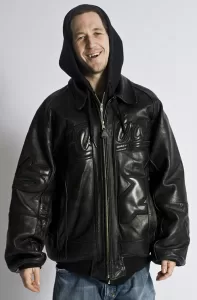
(photo from a fun shoot back in 2007, one year pre-Chinese medical school!)
Acupuncture as a Treatment for Allergies

Allergies affect millions of people worldwide, causing symptoms ranging from mild discomfort to life-threatening reactions. Conventional treatments typically involve antihistamines, corticosteroids, or immunotherapy, but these approaches often address only the symptoms rather than the root cause. As people seek more holistic and natural treatments, acupuncture has emerged as a popular alternative therapy for managing allergies. continue reading
