
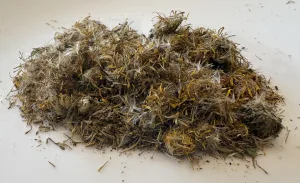
 Meet “Xuan Fu Hua,” or the British Yellowhead flower, an herb commonly used to treat acid reflux, cough, or allergies, outlined in the Divine Farmer’s Materia Medica as “salty, warm, and slightly toxic,” originally indicated for fullness below the rib sides and fright palpitations.
Why? How does the Yellowhead flower achieve this?
Salty flavors and their chemistry have a descending action in the body—one that revolves around the manipulation and distribution of fluids—that is so pathogenic fluids can be purged, allowing for healthy fluids to be re-directed, steamed upwards where they belong.
When the heart lacks blood it is more susceptible to fright and palpitations (it isn’t only your anxiety). When the neuromuscular vessels that traverse the ribs lack fluids, we feel pain or tightness. And in many cases of acid reflux the root of the problem is not an abundance of acid, but a lack of fluids and/or electrolytes around our metabolic organs.
Yellowhead flower is not always the magic bullet for all these conditions; but when their root cause is one of gases and fluids in the body failing to descend, perpetuating a vicious cycle that is due to a void of fluids below in the first place, its formulas are a primary route we’ll hope and suspect to be effective. The opposite physiological patterns of GERD will instead be aggravated, because holistic medicine.
The chemical composition of Yellowhead flower includes quercetin, which comes from the white part of grapefruits and oranges and is often sold as a supplement to treat seasonal allergies; caffeic acid, a polyphenol found in coffee beans; and chlorogenic acid, an antioxidant that is also found in coffee beans. This makes sense as the diuretic effect of coffee is obviously a downward one in the body that subsequently lifts functional chemicals upward in turn.
